


An eclipse is one of nature’s most magical celestial events, when the sun or moon briefly disappears into shadow. Its mystery, beauty, and connection to the cosmos make it a meaningful inspiration for a baby name. 🌑✨
If you’re searching for baby names that mean eclipse, this collection brings together names associated with celestial darkness, the moon, shadows, stars, and the night sky. While few names literally translate to “eclipse,” many beautifully capture its symbolism.
Whether you’re choosing a name for a baby girl, baby boy, or looking for a unisex option, these eclipse-inspired names offer a unique blend of mystery, elegance, and cosmic wonder. 🌙
Boy Names That Mean Eclipse
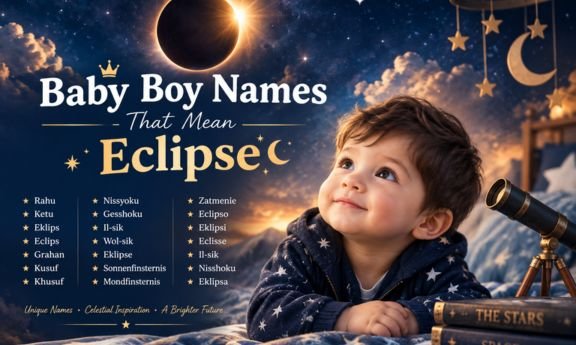
Rahu
- Origin: Sanskrit / Hindu mythology
- Meaning: The celestial demon associated with eclipses
- Description: In Hindu mythology, Rahu is believed to cause solar and lunar eclipses by swallowing the sun or moon.
Ketu
- Origin: Sanskrit / Hindu astrology
- Meaning: The descending lunar node
- Description: Ketu is traditionally associated with eclipses and represents the point where the moon’s orbit intersects the sun’s path.
Eklips
- Origin: Modern / European-inspired
- Meaning: Eclipse
- Description: A modern spelling inspired by the word “eclipse,” symbolizing celestial mystery and shadow.
Eclips
- Origin: Modern / Latin-inspired
- Meaning: Eclipse
- Description: A shortened, contemporary form inspired by the astronomical term for the obscuring of one celestial body by another.
Eklipse
- Origin: Modern / Greek-inspired
- Meaning: Eclipse
- Description: A creative variation of “eclipse,” evoking darkness, transformation, and cosmic wonder.
Nissyoku
- Origin: Japanese (日食)
- Meaning: Solar eclipse
- Description: The Japanese word for solar eclipse, nissyoku literally means “sun-eating” and is the exact term used for a solar eclipse in Japanese.
Gesshoku
- Origin: Japanese (月食)
- Meaning: Lunar eclipse
- Description: The Japanese term for a lunar eclipse, gesshoku refers to the moon being covered by Earth’s shadow.
Il-sik (일식)
- Origin: Korean (일식)
- Meaning: Solar eclipse
- Description: The Korean term for a solar eclipse, il-sik describes the moon passing between the sun and Earth.
Wol-sik (월식)
- Origin: Korean (월식)
- Meaning: Lunar eclipse
- Description: The Korean word for a lunar eclipse, wol-sik refers to Earth’s shadow falling across the moon.
Kasshoku
- Origin: Japanese-inspired
- Meaning: Eclipse; celestial obscuration
- Description: A creative eclipse-inspired name based on Japanese astronomical terminology, symbolizing the mysterious meeting of light and shadow.
Khusuf
- Origin: Arabic (خسوف)
- Meaning: Lunar eclipse
- Description: Khusuf is the Arabic term commonly used for a lunar eclipse, making it a distinctive name connected to the moon and celestial phenomena.
Kusuf
- Origin: Arabic (كسوف)
- Meaning: Solar eclipse
- Description: Kusuf is the Arabic term for a solar eclipse, representing the temporary covering of the sun.
Grahan
- Origin: Sanskrit / Hindi (ग्रहण)
- Meaning: Eclipse
- Description: Grahan means eclipse in Sanskrit and Hindi and is also associated with the traditional concept of celestial bodies being temporarily obscured.
Ekleipsis
- Origin: Greek (ἔκλειψις)
- Meaning: Eclipse; abandonment or disappearance
- Description: Derived from the ancient Greek word ékleipsis, the root of the English word “eclipse,” referring to the disappearance or obscuring of a celestial body.
Eklipsi
- Origin: Greek-inspired / Modern
- Meaning: Eclipse
- Description: A creative name inspired by the Greek root ékleipsis, symbolizing a rare celestial event and the beauty of darkness.
Éclipse
- Origin: French
- Meaning: Eclipse
- Description: The French word for eclipse, éclipse offers a stylish and celestial-inspired choice associated with the moon, sun, and shadow.
Eclisse
- Origin: Italian
- Meaning: Eclipse
- Description: The Italian word for eclipse, eclisse is a lyrical, astronomy-inspired name connected to the temporary obscuring of light.
Eclipse
- Origin: English / Latin-derived
- Meaning: Eclipse
- Description: A direct celestial name representing the dramatic alignment of the sun, moon, and Earth.
Eclipso
- Origin: Modern / Latin-inspired
- Meaning: Eclipse-inspired
- Description: A creative masculine-style variation inspired by “eclipse,” evoking cosmic mystery and celestial transformation.
Sonnenfinsternis
- Origin: German
- Meaning: Solar eclipse
- Description: The German word for solar eclipse, Sonnenfinsternis literally refers to the darkening of the sun.
Mondfinsternis
- Origin: German
- Meaning: Lunar eclipse
- Description: The German term for lunar eclipse, Mondfinsternis describes the moon passing into Earth’s shadow.
Zatmenie
- Origin: Russian / Slavic
- Meaning: Eclipse
- Description: Zatmenie is the Russian word for eclipse, derived from a root associated with darkening or obscuring.
Unique Girl Names That Mean Eclipse
Grihana
- Origin: Sanskrit-inspired
- Meaning: Eclipse; celestial covering
- Description: A creative name inspired by Sanskrit terminology associated with celestial eclipses and the act of seizing or covering.
Eklipsa
- Origin: Modern / European-inspired
- Meaning: Eclipse
- Description: A feminine-style variation inspired by the word “eclipse,” symbolizing celestial beauty and mystery.
Eclipsa
- Origin: Modern / Latin-inspired
- Meaning: Eclipse
- Description: A creative feminine name based on “eclipse,” evoking the moon’s shadow and the wonder of the night sky.
Éclipse
- Origin: French
- Meaning: Eclipse
- Description: The French word for eclipse, offering an elegant and celestial-inspired choice for a girl.
Eclissi
- Origin: Italian-inspired
- Meaning: Eclipse
- Description: A creative variation of the Italian word eclisse, associated with celestial shadow and the temporary disappearance of light.
Eklipsi
- Origin: Greek-inspired / Modern
- Meaning: Eclipse
- Description: A contemporary name inspired by the Greek root for eclipse, symbolizing cosmic wonder and transformation.
Eklipsis
- Origin: Ancient Greek (ἔκλειψις)
- Meaning: Eclipse; disappearance
- Description: The original Greek term behind “eclipse,” referring to the obscuring or disappearance of a celestial body.
Khusufah
- Origin: Arabic-inspired
- Meaning: Lunar eclipse
- Description: A feminine-style variation inspired by khusuf, the Arabic term for a lunar eclipse.
Kusufah
- Origin: Arabic-inspired
- Meaning: Solar eclipse
- Description: A feminine-style variation inspired by kusuf, the Arabic term for a solar eclipse.
Grahani
- Origin: Sanskrit-inspired
- Meaning: Eclipse-related; celestial covering
- Description: A feminine-style name inspired by grahan, the Sanskrit and Hindi word for eclipse.
Eclipsis
- Origin: Latin / Greek
- Meaning: Eclipse; disappearance
- Description: A Latin form derived from Greek ékleipsis, referring to the obscuring of a celestial body.
Gesshoku
- Origin: Japanese (月食)
- Meaning: Lunar eclipse
- Description: The Japanese word for lunar eclipse, gesshoku connects the moon with the mystery of Earth’s shadow.
Wol-sik
- Origin: Korean (월식)
- Meaning: Lunar eclipse
- Description: The Korean term for a lunar eclipse, wol-sik describes the moon being covered by Earth’s shadow.
Sonnenfinsternis
- Origin: German
- Meaning: Solar eclipse
- Description: The German word for solar eclipse, symbolizing the temporary darkening of the sun.
Zatmeniia
- Origin: Ukrainian / Slavic-inspired
- Meaning: Eclipse
- Description: A creative feminine-style variation inspired by Slavic words for eclipse and celestial darkening.
Ecliptica
- Origin: Latin-inspired
- Meaning: Ecliptic; related to eclipses
- Description: Inspired by the astronomical term ecliptic, the apparent path of the sun across the sky where eclipses can occur.
Ekleipsis
- Origin: Ancient Greek (ἔκλειψις)
- Meaning: Eclipse; disappearance
- Description: The ancient Greek word for eclipse, associated with the temporary disappearance of a celestial body.
Cahomreka
- Origin: Maya-inspired
- Meaning: Eclipse-inspired celestial name
- Description: A creative name inspired by Mesoamerican eclipse symbolism and the ancient observation of celestial events.
Rahuketu
- Origin: Sanskrit / Hindu astrology
- Meaning: Rahu and Ketu; lunar nodes
- Description: A combined name referring to the two lunar nodes traditionally associated with eclipses in Hindu astrology.
Grahan
- Origin: Sanskrit / Hindi (ग्रहण)
- Meaning: Eclipse
- Description: A celestial-inspired name meaning eclipse, associated with the temporary obscuring of the sun or moon.
Unisex Names That Mean Eclipse
Eclipse
- Origin: English / Latin-derived
- Meaning: Eclipse
- Description: A direct celestial name representing the alignment of the sun, moon, and Earth.
Grahan
- Origin: Sanskrit / Hindi (ग्रहण)
- Meaning: Eclipse
- Description: Grahan means eclipse and is associated with celestial bodies being temporarily obscured.
Eklips
- Origin: Modern / European-inspired
- Meaning: Eclipse
- Description: A contemporary spelling inspired by “eclipse,” symbolizing cosmic mystery and transformation.
Eklipsi
- Origin: Greek-inspired / Modern
- Meaning: Eclipse
- Description: A creative name inspired by the Greek root ékleipsis, evoking celestial shadow and wonder.
Eclipsis
- Origin: Latin / Greek
- Meaning: Eclipse; disappearance
- Description: A classical form connected to the Greek origin of “eclipse,” referring to the obscuring of a celestial body.
Ekleipsis
- Origin: Ancient Greek (ἔκλειψις)
- Meaning: Eclipse; disappearance
- Description: The ancient Greek term for eclipse, symbolizing a celestial body temporarily disappearing from view.
Khusuf
- Origin: Arabic (خسوف)
- Meaning: Lunar eclipse
- Description: The Arabic term for a lunar eclipse, associated with the moon entering Earth’s shadow.
Kusuf
- Origin: Arabic (كسوف)
- Meaning: Solar eclipse
- Description: The Arabic term for a solar eclipse, representing the temporary covering of the sun.
Rahuketu
- Origin: Sanskrit / Hindu astrology
- Meaning: Lunar nodes associated with eclipses
- Description: A combined name inspired by Rahu and Ketu, the two celestial nodes traditionally linked to eclipses.
Zatmenie
- Origin: Russian / Slavic
- Meaning: Eclipse
- Description: The Russian word for eclipse, associated with darkening and celestial obscuration.
Eclisse
- Origin: Italian
- Meaning: Eclipse
- Description: The Italian word for eclipse, offering a distinctive name connected to celestial shadow.
Il-sik
- Origin: Korean (일식)
- Meaning: Solar eclipse
- Description: The Korean term for a solar eclipse, describing the moon passing between the sun and Earth.
Nisshoku
- Origin: Japanese (日食)
- Meaning: Solar eclipse
- Description: The Japanese word for solar eclipse, nisshoku refers to the sun being obscured by the moon.
Japanese Names That Mean Eclipse
Nissyoku (日食)
- Origin: Japanese
- Meaning: Solar eclipse
- Description: Nissyoku is the Japanese term for a solar eclipse, when the moon passes between the sun and Earth.
Gesshoku (月食)
- Origin: Japanese
- Meaning: Lunar eclipse
- Description: Gesshoku refers to a lunar eclipse, when the moon passes through Earth’s shadow.
Kasshoku (皆食)
- Origin: Japanese-inspired
- Meaning: Total eclipse
- Description: A creative interpretation using Japanese characters associated with totality and eclipse terminology. It is not a standard modern Japanese term for an eclipse.
Kinkan Nissyoku (金環日食)
- Origin: Japanese
- Meaning: Annular solar eclipse
- Description: Kinkan nissyoku describes an annular solar eclipse, in which the moon leaves a bright ring of sunlight visible around it.
Kaikin (皆既)
- Origin: Japanese
- Meaning: Totality; complete
- Description: Kaikin is used in Japanese astronomical expressions to describe a total eclipse, though it is not an eclipse by itself.
Kaikin Gesshoku (皆既月食)
- Origin: Japanese
- Meaning: Total lunar eclipse
- Description: This term refers to a total lunar eclipse, when the entire moon enters Earth’s umbra.
Kaikin Nissyoku (皆既日食)
- Origin: Japanese
- Meaning: Total solar eclipse
- Description: Kaikin nissyoku describes a total solar eclipse, when the moon completely covers the sun’s bright disk.
Bubun Nissyoku (部分日食)
- Origin: Japanese
- Meaning: Partial solar eclipse
- Description: This Japanese term refers to a partial solar eclipse, when only part of the sun is obscured by the moon.
Bubun Gesshoku (部分月食)
- Origin: Japanese
- Meaning: Partial lunar eclipse
- Description: Bubun gesshoku describes a partial lunar eclipse, when only part of the moon enters Earth’s darkest shadow.
Hantei Gesshoku (半影月食)
- Origin: Japanese
- Meaning: Penumbral lunar eclipse
- Description: This term refers to a penumbral lunar eclipse, when the moon passes through the lighter outer region of Earth’s shadow.
Shokki (食既)
- Origin: Japanese astronomical terminology
- Meaning: Beginning of totality
- Description: Shokki is an astronomical term associated with the beginning of totality during an eclipse.
Shokkou (食光)
- Origin: Japanese-inspired
- Meaning: Eclipse light
- Description: A creative combination suggesting light during an eclipse. It is not a common traditional Japanese personal name.
Shodai (初代食)
- Origin: Japanese-inspired
- Meaning: First eclipse; initial phase
- Description: A creative eclipse-inspired expression. Shodai itself commonly means “first generation,” so this compound is not a standard eclipse term.
Saiko (再食)
- Origin: Japanese-inspired
- Meaning: Repeated eclipse
- Description: A creative name suggesting the recurrence of an eclipse. The compound is not a commonly used Japanese astronomical term.
Nichishoku (日蝕)
- Origin: Japanese / Classical Japanese
- Meaning: Solar eclipse
- Description: Nichishoku is an alternative reading associated with the older character form 日蝕, meaning solar eclipse.
Gesshoku-bi (月食日)
- Origin: Japanese-inspired
- Meaning: Lunar eclipse day
- Description: A creative compound combining gesshoku (lunar eclipse) and bi (day), suggesting a day marked by an eclipse.
Shokubun (食分)
- Origin: Japanese astronomical terminology
- Meaning: Eclipse magnitude
- Description: Shokubun refers to the fraction of the sun or moon covered during an eclipse.
Shodoku (食道)
- Origin: Japanese-inspired
- Meaning: Eclipse path; eclipse passage
- Description: A creative eclipse-inspired interpretation. In Japanese, shokudō more commonly refers to an “eating place” or dining hall, not an eclipse path.
Enshoku (円食)
- Origin: Japanese-inspired
- Meaning: Circular eclipse
- Description: A creative compound suggesting the rounded appearance of an eclipsed celestial body. It is not a standard Japanese eclipse term.
Zentai Shoku (全体食)
- Origin: Japanese-inspired
- Meaning: Total eclipse
- Description: A creative expression combining zentai (whole or entire) with shoku (eclipse or occultation). It is not the standard Japanese term for totality.
Last Names That Mean Eclipse
Eclipse
- Origin: English / Latin-derived
- Meaning: Eclipse
- Description: A distinctive surname-style choice directly inspired by the celestial event in which one astronomical body obscures another.
Grahan
- Origin: Sanskrit / Hindi
- Meaning: Eclipse
- Description: Grahan means eclipse and is associated with the temporary obscuring of the sun or moon.
Eklips
- Origin: Modern / European-inspired
- Meaning: Eclipse
- Description: A contemporary surname-style variation inspired by the word “eclipse.”
Eclissi
- Origin: Italian
- Meaning: Eclipse
- Description: Eclissi is the Italian plural form of eclisse, meaning eclipses. It can serve as a creative surname-inspired choice.
Khusuf
- Origin: Arabic
- Meaning: Lunar eclipse
- Description: Khusuf is the Arabic term commonly used for a lunar eclipse.
Kusuf
- Origin: Arabic
- Meaning: Solar eclipse
- Description: Kusuf is the Arabic term for a solar eclipse.
Gesshoku
- Origin: Japanese
- Meaning: Lunar eclipse
- Description: Gesshoku is the Japanese astronomical term for a lunar eclipse.
Nissyoku
- Origin: Japanese
- Meaning: Solar eclipse
- Description: Nissyoku is the Japanese term for a solar eclipse.
Eklipsa
- Origin: Modern / European-inspired
- Meaning: Eclipse
- Description: A creative surname-style variation inspired by the word “eclipse,” with a soft, distinctive ending.
Zatmenie
- Origin: Russian
- Meaning: Eclipse
- Description: Zatmenie is the Russian word for eclipse, associated with darkening or obscuring.
Ekleipsis
- Origin: Ancient Greek
- Meaning: Eclipse; disappearance
- Description: Ekleipsis is the Greek word from which the English term “eclipse” originated.
Ecliptica
- Origin: Latin-inspired / Astronomy
- Meaning: Ecliptic; related to eclipses
- Description: Inspired by the astronomical term ecliptic, the apparent path of the sun across the sky.
Il-sik
- Origin: Korean
- Meaning: Solar eclipse
- Description: Il-sik is the Korean term for a solar eclipse.
Wol-sik
- Origin: Korean
- Meaning: Lunar eclipse
- Description: Wol-sik is the Korean term for a lunar eclipse.
Eclipson
- Origin: Modern / English-inspired
- Meaning: Eclipse-inspired
- Description: A creative surname-style name formed from “eclipse,” suggesting a connection to celestial mystery and shadow.
Also read this: Baby Names That Mean Betrayal
Greek Names That Mean Eclipse
Ekleipsis (ἔκλειψις)
- Origin: Ancient Greek
- Meaning: Eclipse; disappearance
- Description: Ekleipsis is the ancient Greek word for eclipse and the root of the English term.
Eklipsi (Έκλειψη)
- Origin: Modern Greek
- Meaning: Eclipse
- Description: Eklipsi is the modern Greek word for an eclipse, referring to the obscuring of one celestial body by another.
Iliaki Eklipsi (Ηλιακή Έκλειψη)
- Origin: Greek
- Meaning: Solar eclipse
- Description: Iliaki eklipsi is the Greek term for a solar eclipse, when the moon blocks the sun.
Seliniaki Eklipsi (Σεληνιακή Έκλειψη)
- Origin: Greek
- Meaning: Lunar eclipse
- Description: This Greek expression refers to a lunar eclipse, when Earth’s shadow falls on the moon.
Olikí Eklipsi (Ολική Έκλειψη)
- Origin: Greek
- Meaning: Total eclipse
- Description: Olikí eklipsi means total eclipse, describing an eclipse in which the covering is complete.
Merikí Eklipsi (Μερική Έκλειψη)
- Origin: Greek
- Meaning: Partial eclipse
- Description: This term means partial eclipse, when only part of a celestial body is obscured.
Daktylioeidís Eklipsi (Δακτυλιοειδής Έκλειψη)
- Origin: Greek
- Meaning: Annular eclipse
- Description: This expression refers to an annular eclipse, in which a bright ring remains visible around the moon.
Eklipsis Iliou (Έκλειψη Ηλίου)
- Origin: Greek
- Meaning: Eclipse of the sun
- Description: Eklipsis iliou is a Greek expression for a solar eclipse.
Eklipsis Selinis (Έκλειψη Σελήνης)
- Origin: Greek
- Meaning: Eclipse of the moon
- Description: This Greek expression refers to a lunar eclipse.
Apokrypsi (Απόκρυψη)
- Origin: Greek
- Meaning: Concealment; hiding
- Description: Apokrypsi means concealment or hiding, making it symbolically connected to the way an eclipse obscures light.
Skepasmos (Σκεπασμός)
- Origin: Greek
- Meaning: Covering; veiling
- Description: Skepasmos refers to covering or sheltering and can symbolize the moon’s temporary covering of the sun.
Katakrypsi (Κατακρύψη)
- Origin: Greek-inspired
- Meaning: Concealment; hiding
- Description: A creative eclipse-inspired form associated with the idea of something being hidden or obscured.
Paraskiasmos (Παρασκιασμός)
- Origin: Greek-inspired
- Meaning: Shadowing; casting a shadow
- Description: A creative term inspired by the concept of shadowing, which is central to lunar and solar eclipses.
Epikalypsi (Επικάλυψη)
- Origin: Greek
- Meaning: Covering; overlay
- Description: Epikalypsi means covering or overlaying, symbolically reflecting the way one celestial body covers another.
Antikalypsi (Αντικάλυψη)
- Origin: Greek-inspired
- Meaning: Counter-covering; opposing overlay
- Description: A creative compound inspired by the idea of overlapping or covering celestial bodies.
Iliaki Skia (Ηλιακή Σκιά)
- Origin: Greek
- Meaning: Solar shadow
- Description: Iliaki skia combines “solar” and “shadow,” evoking the darkened appearance associated with an eclipse.
Eklipsiakos (Εκλειψιακός)
- Origin: Greek-inspired
- Meaning: Eclipse-related
- Description: A creative adjective-style name derived from the Greek root for eclipse, suggesting a celestial connection.
Kanon Ekleipseon (Κανών Εκλείψεων)
- Origin: Greek
- Meaning: Canon or cycle of eclipses
- Description: This expression refers to a system or collection related to eclipse calculations and cycles.
Periodikí Eklipsi (Περιοδική Έκλειψη)
- Origin: Greek
- Meaning: Periodic eclipse
- Description: Periodikí eklipsi means periodic eclipse, highlighting the recurring nature of celestial alignments.
Eklipsiologia (Εκλειψιολογία)
- Origin: Greek-inspired
- Meaning: Study of eclipses
- Description: A creative term inspired by the Greek roots for eclipse and study, suggesting the science of eclipse observation.
Korean Names That Mean Eclipse
Il-sik (일식 / 日食)
- Origin: Korean
- Meaning: Solar eclipse
- Description: Il-sik is the Korean term for a solar eclipse, when the moon passes between the sun and Earth.
Wol-sik (월식 / 月食)
- Origin: Korean
- Meaning: Lunar eclipse
- Description: Wol-sik refers to a lunar eclipse, when Earth’s shadow falls across the moon.
Gaegi Il-sik (개기일식)
- Origin: Korean
- Meaning: Total solar eclipse
- Description: Gaegi il-sik describes a total solar eclipse, when the moon completely covers the sun’s bright disk.
Gaegi Wol-sik (개기월식)
- Origin: Korean
- Meaning: Total lunar eclipse
- Description: This term refers to a total lunar eclipse, when the moon fully enters Earth’s umbra.
Bubun Il-sik (부분일식)
- Origin: Korean
- Meaning: Partial solar eclipse
- Description: Bubun il-sik means partial solar eclipse, when only part of the sun is covered.
Bubun Wol-sik (부분월식)
- Origin: Korean
- Meaning: Partial lunar eclipse
- Description: This expression refers to a partial lunar eclipse, when part of the moon enters Earth’s darkest shadow.
Geumsil Il-sik (금환일식)
- Origin: Korean
- Meaning: Annular solar eclipse
- Description: Geumsil il-sik describes an annular solar eclipse, when a bright ring of sunlight remains visible.
Il-sik-dae (일식대)
- Origin: Korean astronomical terminology
- Meaning: Solar eclipse zone
- Description: Il-sik-dae refers to the zone or belt associated with the path of a solar eclipse.
Sik-bun (식분)
- Origin: Korean astronomical terminology
- Meaning: Eclipse magnitude
- Description: Sik-bun refers to the fraction of the sun or moon covered during an eclipse.
Gaegi-dae (개기대)
- Origin: Korean astronomical terminology
- Meaning: Totality zone
- Description: A term associated with the region where a total eclipse can be observed.
Ban-yeong Wol-sik (반영월식)
- Origin: Korean
- Meaning: Penumbral lunar eclipse
- Description: This expression refers to a lunar eclipse involving Earth’s penumbra, or outer shadow.
Il-sik Nyeon (일식년)
- Origin: Korean-inspired
- Meaning: Solar eclipse year
- Description: A creative compound combining solar eclipse with year, suggesting a year marked by an eclipse.
Wol-sik Saek (월식색)
- Origin: Korean-inspired
- Meaning: Lunar eclipse color
- Description: A creative expression referring to the reddish or altered color sometimes seen during a lunar eclipse.
Sik-ssi (식시)
- Origin: Korean astronomical terminology
- Meaning: Eclipse time
- Description: A creative eclipse-related term suggesting the time or timing of an eclipse.
Il-sik Gyeong-ro (일식경로)
- Origin: Korean
- Meaning: Solar eclipse path
- Description: Il-sik gyeong-ro refers to the path or track of a solar eclipse.
Wol-sik-il (월식일)
- Origin: Korean-inspired
- Meaning: Lunar eclipse day
- Description: A creative compound combining lunar eclipse with day, symbolizing a date marked by a celestial event.
Hyeol-wol (혈월)
- Origin: Korean
- Meaning: Blood moon
- Description: Hyeol-wol means blood moon, a term often associated with the reddish appearance of the moon during a total lunar eclipse.
Sik-gyeong (식경)
- Origin: Korean-inspired
- Meaning: Eclipse path or passage
- Description: A creative eclipse-inspired compound suggesting the path or progression of an eclipse.
Gaegi Gyeong-gwa (개기경과)
- Origin: Korean-inspired
- Meaning: Totality passage
- Description: A creative expression referring to the progression or passage of totality during an eclipse.
Sik-do (식도)
- Origin: Korean-inspired
- Meaning: Eclipse path
- Description: A creative name inspired by eclipse terminology, suggesting the path or route of a celestial shadow.
French Names That Mean Eclipse
Éclipse
- Origin: French
- Meaning: Eclipse
- Description: Éclipse is the French word for eclipse, referring to the temporary obscuring of a celestial body.
Éclipse Solaire
- Origin: French
- Meaning: Solar eclipse
- Description: This French expression refers to an eclipse of the sun caused by the moon passing in front of it.
Éclipse Lunaire
- Origin: French
- Meaning: Lunar eclipse
- Description: Éclipse lunaire means lunar eclipse, when Earth’s shadow falls on the moon.
Éclipse Totale
- Origin: French
- Meaning: Total eclipse
- Description: This term describes an eclipse in which the obscuring of the celestial body is complete.
Éclipse Partielle
- Origin: French
- Meaning: Partial eclipse
- Description: Éclipse partielle refers to an eclipse in which only part of a celestial body is obscured.
Éclipse Annulaire
- Origin: French
- Meaning: Annular eclipse
- Description: This expression describes an annular eclipse, when a bright ring remains visible around the moon.
Éclipse de Soleil
- Origin: French
- Meaning: Solar eclipse
- Description: Éclipse de soleil literally means eclipse of the sun.
Éclipse de Lune
- Origin: French
- Meaning: Lunar eclipse
- Description: This phrase means eclipse of the moon and refers to Earth’s shadow crossing the lunar surface.
Écliptique
- Origin: French / Greek-derived
- Meaning: Ecliptic
- Description: Écliptique is the French astronomical term for the apparent path of the sun across the sky.
Éclipseur
- Origin: French-inspired
- Meaning: One who eclipses; eclipse-related
- Description: A creative name inspired by the French root éclipse, suggesting something that obscures or outshines.
Éclipsé
- Origin: French
- Meaning: Eclipsed; obscured
- Description: Éclipsé means eclipsed or hidden from view, making it symbolically connected to celestial shadow.
Phénomène d’Éclipse
- Origin: French
- Meaning: Eclipse phenomenon
- Description: This phrase refers to the natural astronomical phenomenon of an eclipse.
Lune Éclipsée
- Origin: French
- Meaning: Eclipsed moon
- Description: Lune éclipsée means eclipsed moon, evoking the moon during a lunar eclipse.
Soleil Éclipsé
- Origin: French
- Meaning: Eclipsed sun
- Description: This expression means eclipsed sun, describing the sun when it is partially or totally obscured.
Totalité d’Éclipse
- Origin: French astronomical terminology
- Meaning: Eclipse totality
- Description: Totalité d’éclipse refers to the phase or region of totality during an eclipse.
Occultation
- Origin: French / Latin-derived
- Meaning: Occultation; concealment
- Description: Occultation refers to one celestial body passing in front of and hiding another.
Ombre d’Éclipse
- Origin: French
- Meaning: Eclipse shadow
- Description: This phrase combines “shadow” and “eclipse,” symbolizing the dark region cast during a celestial event.
Couronne d’Éclipse
- Origin: French
- Meaning: Eclipse corona
- Description: Couronne d’éclipse evokes the solar corona visible around the moon during a total solar eclipse.
Pénombre
- Origin: French / Latin-derived
- Meaning: Penumbra; partial shadow
- Description: Pénombre means partial shadow or half-light, a beautiful symbol of the soft darkness associated with eclipses.
Magnitude d’Éclipse
- Origin: French astronomical terminology
- Meaning: Eclipse magnitude
- Description: This term refers to the amount or fraction of a celestial body covered during an eclipse.
German Names That Mean Eclipse
Sonnenfinsternis
- Origin: German
- Meaning: Solar eclipse
- Description: Sonnenfinsternis is the German word for solar eclipse, referring to the moon obscuring the sun.
Mondfinsternis
- Origin: German
- Meaning: Lunar eclipse
- Description: Mondfinsternis is the German term for lunar eclipse, when Earth’s shadow falls on the moon.
Finsternis
- Origin: German
- Meaning: Darkness; eclipse
- Description: Finsternis means darkness and can also be used in compounds describing an eclipse.
Totale Sonnenfinsternis
- Origin: German
- Meaning: Total solar eclipse
- Description: This expression refers to a total solar eclipse, when the moon completely covers the sun’s bright disk.
Totale Mondfinsternis
- Origin: German
- Meaning: Total lunar eclipse
- Description: Totale Mondfinsternis describes a total lunar eclipse, when the moon fully enters Earth’s umbra.
Partielle Sonnenfinsternis
- Origin: German
- Meaning: Partial solar eclipse
- Description: This German term refers to a partial solar eclipse, when only part of the sun is obscured.
Partielle Mondfinsternis
- Origin: German
- Meaning: Partial lunar eclipse
- Description: Partielle Mondfinsternis describes a partial lunar eclipse, when part of the moon enters Earth’s darkest shadow.
Ringförmige Sonnenfinsternis
- Origin: German
- Meaning: Annular solar eclipse
- Description: This expression refers to an annular solar eclipse, when a bright ring of sunlight remains visible.
Eklipse
- Origin: German / Greek-derived
- Meaning: Eclipse
- Description: Eklipse is a German word for eclipse and is directly connected to the astronomical event.
Finsterniszone
- Origin: German
- Meaning: Eclipse zone; shadow zone
- Description: A compound combining Finsternis (darkness) and Zone (zone), suggesting a region affected by an eclipse.
Finsternispfad
- Origin: German
- Meaning: Eclipse path
- Description: Finsternispfad combines “eclipse” or “darkness” with “path,” referring to the path of an eclipse’s shadow.
Sonnenfinsternistag
- Origin: German-inspired
- Meaning: Solar eclipse day
- Description: A compound meaning “solar eclipse day,” symbolizing a memorable celestial occasion.
Mondfinsternistag
- Origin: German-inspired
- Meaning: Lunar eclipse day
- Description: This compound combines lunar eclipse with day, suggesting a day marked by a lunar event.
Finsternisperiode
- Origin: German
- Meaning: Eclipse period
- Description: Finsternisperiode refers to a period associated with eclipses or recurring celestial darkening.
Halbschatten-Mondfinsternis
- Origin: German
- Meaning: Penumbral lunar eclipse
- Description: This term describes a lunar eclipse in which the moon passes through Earth’s lighter outer shadow.
Kernschatten-Mondfinsternis
- Origin: German
- Meaning: Umbra lunar eclipse
- Description: This expression refers to a lunar eclipse involving Earth’s central, darkest shadow.
Ekliptik
- Origin: German / Greek-derived
- Meaning: Ecliptic
- Description: Ekliptik is the German astronomical term for the apparent path of the sun across the sky.
Finsternisrechnung
- Origin: German
- Meaning: Eclipse calculation
- Description: This compound refers to the calculation or prediction of eclipses.
Saros-Periode
- Origin: Greek-derived astronomical terminology
- Meaning: Saros cycle
- Description: The Saros period is an astronomical cycle used to understand the recurrence of similar eclipses.
Finsternisdauer
- Origin: German
- Meaning: Eclipse duration
- Description: Finsternisdauer refers to the length of time an eclipse lasts.
Spanish Names That Mean Eclipse
Eclipse
- Origin: Spanish / Greek-derived
- Meaning: Eclipse
- Description: Eclipse is the Spanish word for eclipse, referring to the temporary obscuring of one celestial body by another.
Luna
- Origin: Spanish / Latin
- Meaning: Moon
- Description: Luna means moon in Spanish and is symbolically connected to lunar eclipses and the night sky.
Sol
- Origin: Spanish / Latin
- Meaning: Sun
- Description: Sol means sun in Spanish and represents the celestial body involved in a solar eclipse.
Luz
- Origin: Spanish / Latin
- Meaning: Light
- Description: Luz means light, symbolizing the glow that returns after the darkness of an eclipse.
Lucía
- Origin: Spanish / Latin
- Meaning: Light
- Description: Lucía is a Spanish name derived from lux, the Latin word for light, offering a hopeful contrast to eclipse shadow.
Lucio
- Origin: Spanish / Latin
- Meaning: Light
- Description: Lucio is a Spanish masculine name derived from the Latin lux, meaning light.
Selena
- Origin: Spanish usage / Greek
- Meaning: Moon
- Description: Selena is associated with the Greek moon goddess Selene, making it a fitting lunar-inspired name.
Selene
- Origin: Greek
- Meaning: Moon
- Description: Selene is the Greek moon goddess, symbolizing lunar beauty and celestial mystery.
Diana
- Origin: Spanish usage / Latin
- Meaning: Divine; moon-associated
- Description: Diana is traditionally associated with the moon in Roman mythology, making it a celestial-inspired choice.
Celia
- Origin: Spanish / Latin
- Meaning: Heavenly
- Description: Celia is related to the Latin caelestis, meaning heavenly or celestial.
Celeste
- Origin: Spanish / Latin
- Meaning: Heavenly; celestial
- Description: Celeste means heavenly or celestial, making it a beautiful name inspired by the sky and stars.
Estrella
- Origin: Spanish / Latin
- Meaning: Star
- Description: Estrella means star in Spanish and evokes the beauty of the night sky during a celestial event.
Estela
- Origin: Spanish / Latin
- Meaning: Star; trail of light
- Description: Estela is associated with the Latin stella, meaning star, and can symbolize a trail of light in darkness.
Asteria
- Origin: Greek / Mythology
- Meaning: Starry; of the stars
- Description: Asteria is associated with stars and celestial mythology, making it an enchanting eclipse-inspired name.
Astrid
- Origin: Old Norse; used internationally
- Meaning: Divinely beautiful
- Description: Astrid is not a Spanish name, but its star-like association makes it a popular celestial-inspired choice.
Aurora
- Origin: Spanish usage / Latin
- Meaning: Dawn
- Description: Aurora means dawn and symbolizes the return of light after the darkness of an eclipse.
Noche
- Origin: Spanish
- Meaning: Night
- Description: Noche means night in Spanish, evoking the darkness and mystery of a solar eclipse.
Sombra
- Origin: Spanish
- Meaning: Shadow
- Description: Sombra means shadow in Spanish and directly reflects the central imagery of an eclipse.
Oscura
- Origin: Spanish
- Meaning: Dark; shadowy
- Description: Oscura is the feminine form of oscuro, meaning dark, and evokes the mysterious darkness of an eclipse.
Oscuro
- Origin: Spanish
- Meaning: Dark; shadowy
- Description: Oscuro means dark in Spanish and symbolizes the temporary absence of light during an eclipse.
Umbría
- Origin: Spanish / Latin-derived
- Meaning: Shady; shadowed
- Description: Umbría is associated with shade or shadow and offers a poetic connection to eclipse imagery.
Umbral
- Origin: Spanish / Latin-derived
- Meaning: Threshold; shadow-related
- Description: Umbral means threshold in Spanish and is also reminiscent of the umbra, the darkest part of a shadow.
Crepúsculo
- Origin: Spanish / Latin
- Meaning: Twilight
- Description: Crepúsculo means twilight, the soft transition between daylight and darkness, much like the atmosphere of an eclipse.
Nocturna
- Origin: Spanish / Latin-derived
- Meaning: Of the night
- Description: Nocturna is a feminine-style form associated with nighttime and celestial darkness.
Nocturno
- Origin: Spanish / Latin-derived
- Meaning: Nocturnal; of the night
- Description: Nocturno means nocturnal or related to the night, evoking the mysterious beauty of an eclipse.
Cielo
- Origin: Spanish
- Meaning: Sky; heaven
- Description: Cielo means sky or heaven in Spanish and connects to the celestial setting of an eclipse.
Marisol
- Origin: Spanish
- Meaning: María and Sol; associated with the sun
- Description: Marisol is commonly understood as a combination of María and sol (sun), giving it a warm celestial association.
Solana
- Origin: Spanish / Latin-derived
- Meaning: Sunny place; sunshine
- Description: Solana is associated with sunlight and a sunny place, symbolizing the light surrounding an eclipse.
Lunaria
- Origin: Latin / Spanish-inspired
- Meaning: Moon-related
- Description: Lunaria is derived from luna, meaning moon, and evokes lunar beauty and celestial mystery.
Eclipsia
- Origin: Modern / Spanish-inspired
- Meaning: Eclipse-inspired
- Description: Eclipsia is a creative feminine-style name inspired by eclipse, symbolizing celestial shadow and wonder.
Frequently Asked Questions
FAQs About Baby Names That Mean Eclipse
1. What name means eclipse?
Eclipse is a direct name meaning eclipse, while Grahan, Ekleipsis, and Eklipsi are inspired by words for this celestial event.
2. What Japanese name means eclipse?
Nissyoku means solar eclipse, while Gesshoku means lunar eclipse in Japanese.
3. What girl name means eclipse?
Eklipsa, Eclipsa, and Eclipsia are creative girl names inspired by the word eclipse.
4. What boy name means eclipse?
Rahu, Ketu, and Grahan are masculine-style names associated with eclipses and celestial mythology.
5. Are eclipse-inspired names unisex?
Yes, names such as Eclipse, Grahan, Eklipsi, and Ekleipsis can work as unique unisex choices.
Conclusion
Choosing a name inspired by an eclipse can be a beautiful way to celebrate mystery, wonder, and the magic of the universe. From moon-related names to words connected with shadow and celestial light, these choices offer something truly distinctive. 🌑✨
Whether you prefer a traditional name like Rahu, a Japanese-inspired choice like Nissyoku, or a creative option such as Eclipsa, each name carries a unique connection to the beauty of the cosmos.
We hope this collection of 100+ baby girl and boy names that mean eclipse helps you find a name that feels meaningful, memorable, and perfect for your little one. 🌙
