

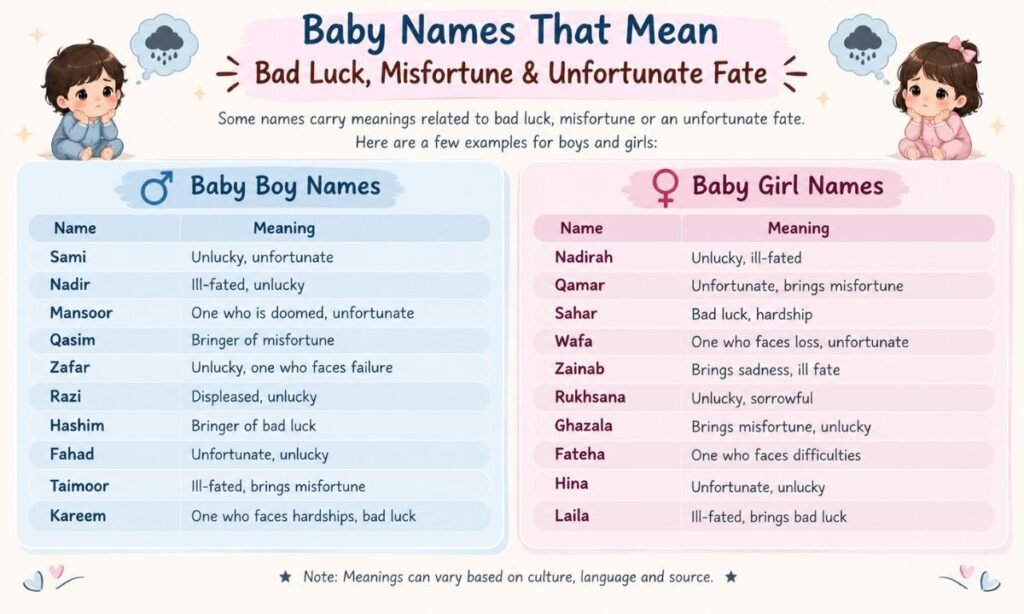
Choosing a baby name with a unique meaning can be a fascinating way to explore different cultures, languages, and traditions. While many parents look for names associated with happiness, strength, or good fortune, some are interested in unusual meanings connected to life’s darker or more mysterious themes.
In this collection of 75+ baby names that mean bad luck, misfortune, or unfortunate fate, you’ll discover distinctive names inspired by mythology, history, literature, and various languages. Some names have direct meanings related to misfortune, while others are associated with unlucky events, difficult circumstances, or tragic fate.
Whether you’re researching names for a fictional character, exploring cultural naming traditions, or simply curious about rare baby names and their meanings, this list offers plenty of intriguing options for names
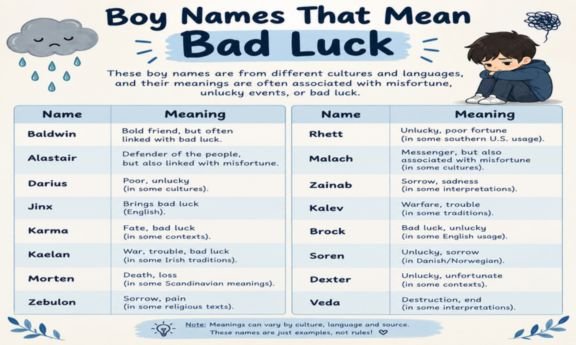
Boy Names That Mean Bad Luck
Mallory
- Origin: Old French
- Meaning: Unfortunate, unlucky
- Description: Mallory comes from an Old French surname associated with the idea of being unfortunate or unlucky. It is now used as a modern given name.
Anay
- Origin: Indian/Sanskrit usage
- Meaning: Unfortunate or without a leader in some interpretations
- Description: Anay is a short and distinctive name found in South Asian naming traditions. Its association with misfortune depends on the interpretation and source.
Nhamo
- Origin: Shona
- Meaning: Misfortune, trouble
- Description: Nhamo is a Shona name traditionally associated with difficult circumstances or misfortune.
Makiadi
- Origin: African
- Meaning: Misfortune
- Description: Makiadi is an uncommon name associated with hardship or unfortunate circumstances in some naming references.
Luvinda
- Origin: African usage
- Meaning: Misfortune, unfortunate
- Description: Luvinda is a rare name associated with an unfortunate situation or difficult fate.
Owiti
- Origin: Luo
- Meaning: Born after misfortune or difficult circumstances
- Description: Owiti is a Luo name traditionally connected with circumstances surrounding a child’s birth and hardship.
Fuun
- Origin: Japanese (不運)
- Meaning: Bad luck, misfortune
- Description: Fuun literally means “bad luck” or “misfortune” in Japanese and works particularly well as a symbolic or fictional name.
Yakubyou
- Origin: Japanese (厄病)
- Meaning: Misfortune, calamity, disease
- Description: Yakubyou combines Japanese concepts associated with misfortune and illness. It is primarily a Japanese term rather than a conventional given name.
Yakuotoko
- Origin: Japanese (厄男)
- Meaning: Unlucky man
- Description: Yakuotoko literally refers to an “unlucky man” in Japanese and is better suited to fictional or symbolic naming.
Suiun
- Origin: Japanese (衰運)
- Meaning: Declining fortune, bad luck
- Description: Suiun refers to declining fortune or a period when one’s luck is turning unfavorable.
Ashagna
- Origin: Sanskrit/Indian usage
- Meaning: Unfortunate or unlucky
- Description: Ashagna is a rare name appearing in some modern naming sources with associations to unfavorable circumstances.
Malheur
- Origin: French
- Meaning: Misfortune, bad luck
- Description: Malheur is the French word for “misfortune” or “bad luck.” It is more commonly a vocabulary word than a traditional personal name.
Malchance
- Origin: French
- Meaning: Bad luck, ill fortune
- Description: Malchance literally means “bad luck” in French and makes an unusual symbolic name for fictional characters.
Bolvar
- Origin: European/Spanish usage
- Meaning: Associated with hardship or unfortunate fate
- Description: Bolvar is an uncommon name and its association with bad luck is found mainly in modern naming references rather than established etymology.
Malasuerte
- Origin: Spanish
- Meaning: Bad luck
- Description: Malasuerte combines Spanish mala (“bad”) and suerte (“luck”), literally expressing the idea of bad fortune.
Dystyches
- Origin: Greek
- Meaning: Unfortunate, unlucky
- Description: Dystyches comes from Greek and is associated with being unfortunate or experiencing bad fortune.
Kakotychos
- Origin: Greek (Κακότυχος)
- Meaning: Unlucky, ill-fated
- Description: Kakotychos is derived from Greek elements associated with “bad” and “fortune,” giving it the meaning “unlucky” or “ill-fated.”
Durbhagya
- Origin: Sanskrit
- Meaning: Misfortune, bad luck
- Description: Durbhagya comes from Sanskrit and directly refers to misfortune, bad fortune, or an unlucky condition.
Abhagya
- Origin: Sanskrit/Indian
- Meaning: Unfortunate, unlucky
- Description: Abhagya is connected with Sanskrit terminology describing a lack of good fortune or an unfortunate state.
Naseeb-e-Bad
- Origin: Urdu/Persian-Arabic
- Meaning: Bad fate, unfortunate destiny
- Description: Naseeb-e-Bad combines naseeb (“fate” or “destiny”) with bad (“bad”), creating the meaning “bad fate.”
Also read Names that means Sleep
Unique Girl Names That Mean Bad Luck
Mallory
- Origin: Old French
- Meaning: Unfortunate, unlucky
- Description: Mallory has Old French roots and is traditionally connected with the meaning “unfortunate” or “unlucky.”
Desdemona
- Origin: Greek
- Meaning: Ill-fated, unfortunate
- Description: Desdemona is a literary name strongly associated with tragic and unfortunate circumstances, especially through Shakespeare’s Othello.
Anaya
- Origin: South Asian usage
- Meaning: Unfortunate or without protection in some interpretations
- Description: Anaya is a popular modern name with multiple proposed origins and meanings. Its association with misfortune varies considerably by naming source.
Awiti
- Origin: Luo
- Meaning: Born after hardship or misfortune
- Description: Awiti is a Luo name associated in traditional naming contexts with difficult circumstances surrounding birth.
Nhamo
- Origin: Shona
- Meaning: Misfortune, trouble
- Description: Nhamo is a Shona name connected with hardship or misfortune and can be used for a distinctive symbolic character name.
Symphora
- Origin: Greek
- Meaning: Misfortune, calamity
- Description: Symphora is related to the Greek word symphora, which can refer to an event, circumstance, or misfortune.
Makiadi
- Origin: African
- Meaning: Misfortune
- Description: Makiadi is a rare name associated with hardship or unfortunate circumstances in some naming references.
Luvinda
- Origin: African usage
- Meaning: Misfortune, unfortunate
- Description: Luvinda is an uncommon name connected in some sources with unfortunate circumstances or difficult fate.
Malheureuse
- Origin: French
- Meaning: Unfortunate, unlucky
- Description: Malheureuse is the feminine French form associated with being unfortunate or unlucky.
Dysmona
- Origin: Greek-inspired
- Meaning: Unfortunate, ill-fated
- Description: Dysmona is associated with Greek-derived concepts of difficult fortune and an unfavorable destiny.
Yakuonna
- Origin: Japanese-inspired
- Meaning: Unlucky woman
- Description: Yakuonna is formed from Japanese elements associated with misfortune and “woman.” It is more appropriate as a symbolic or fictional name.
Fuun
- Origin: Japanese (不運)
- Meaning: Bad luck, misfortune
- Description: Fuun directly means “bad luck” or “misfortune” in Japanese.
Ashagna
- Origin: Sanskrit/Indian usage
- Meaning: Unfortunate, unlucky
- Description: Ashagna is a rare name associated with unfavorable circumstances in some modern naming references.
Malasuerte
- Origin: Spanish
- Meaning: Bad luck
- Description: Malasuerte literally means “bad luck” in Spanish and is an unusual choice for a dark fictional or symbolic character.
Durbhagya
- Origin: Sanskrit
- Meaning: Misfortune, bad luck
- Description: Durbhagya directly describes misfortune or bad fortune in Sanskrit-derived usage.
Abhagyavati
- Origin: Sanskrit
- Meaning: Unfortunate woman, unlucky woman
- Description: Abhagyavati is a feminine Sanskrit-derived form associated with a woman experiencing misfortune or lack of good fortune.
Dystychia
- Origin: Greek
- Meaning: Misfortune, bad luck
- Description: Dystychia comes from Greek and is associated with misfortune, unlucky circumstances, or unfortunate fate.
Suiun
- Origin: Japanese (衰運)
- Meaning: Declining fortune, bad luck
- Description: Suiun refers to declining luck or fortune and is primarily a Japanese term rather than a traditional given name.
Malchance
- Origin: French
- Meaning: Bad luck, misfortune
- Description: Malchance literally means “bad luck” in French and can work as an unusual literary or fictional name.
Kakotychis
- Origin: Greek
- Meaning: Unlucky, ill-fated
- Description: Kakotychis is a feminine Greek-derived form associated with bad fortune or an unfortunate fate.
Unisex Names That Mean Bad Luck
Mallory
- Origin: Old French
- Meaning: Unfortunate, unlucky
- Description: Mallory is a gender-neutral modern name with Old French roots associated with being unfortunate or unlucky.
Makiadi
- Origin: African
- Meaning: Misfortune
- Description: Makiadi is a rare name associated with hardship or misfortune in some naming references.
Nhamo
- Origin: Shona
- Meaning: Misfortune, trouble
- Description: Nhamo is traditionally connected with difficult circumstances and misfortune in Shona naming traditions.
Luvinda
- Origin: African usage
- Meaning: Unfortunate, misfortune
- Description: Luvinda is an uncommon name associated with hardship or unfortunate circumstances.
Fuun
- Origin: Japanese (不運)
- Meaning: Bad luck, misfortune
- Description: Fuun literally means “bad luck” or “misfortune” in Japanese and can be used as a symbolic unisex name.
Anay / Anaya
- Origin: South Asian usage
- Meaning: Unfortunate or without protection in some interpretations
- Description: Anay and Anaya appear in modern naming sources with multiple meanings and origins. Their association with misfortune depends on the source.
Ashagna
- Origin: Sanskrit/Indian usage
- Meaning: Unfortunate, unlucky
- Description: Ashagna is a rare name connected with unfavorable circumstances in some modern naming references.
Malchance
- Origin: French
- Meaning: Bad luck, ill fortune
- Description: Malchance literally means “bad luck” in French, making it a distinctive gender-neutral choice for fictional naming.
Malasuerte
- Origin: Spanish
- Meaning: Bad luck
- Description: Malasuerte combines Spanish words meaning “bad” and “luck,” directly expressing the idea of misfortune.
Yakubyou
- Origin: Japanese (厄病)
- Meaning: Misfortune, calamity
- Description: Yakubyou is a Japanese term associated with misfortune and illness. It is better suited to symbolic or fictional naming.
Durbhagya
- Origin: Sanskrit
- Meaning: Bad luck, misfortune
- Description: Durbhagya directly refers to misfortune or bad fortune and can be used as a distinctive symbolic name.
Abhagya
- Origin: Sanskrit/Indian
- Meaning: Unfortunate, unlucky
- Description: Abhagya is associated with an absence of good fortune and an unfortunate condition.
Suiun
- Origin: Japanese (衰運)
- Meaning: Declining fortune, bad luck
- Description: Suiun describes declining fortune or unfavorable luck and has a mysterious quality as a symbolic name.
Symphora
- Origin: Greek
- Meaning: Misfortune, unfortunate circumstance
- Description: Symphora is related to a Greek term associated with circumstances, events, or misfortune.
Owiti / Awiti
- Origin: Luo
- Meaning: Associated with hardship or difficult circumstances
- Description: Owiti and Awiti are Luo names traditionally connected with circumstances surrounding birth, including hardship or misfortune.
Yes. I’ll format these sections exactly like the previous ones, with Origin, Meaning, and Description under every H3. I’ll also keep the wording SEO-friendly and note when a term is better understood as a word/phrase than a traditional given name.
Japanese Names That Mean Bad Luck
Fuun (不運)
- Origin: Japanese
- Meaning: Bad luck, misfortune
- Description: Fuun (不運) directly means “bad luck” or “misfortune” in Japanese. It is primarily a vocabulary term rather than a traditional Japanese given name.
Yakubyou (厄病)
- Origin: Japanese
- Meaning: Misfortune, illness
- Description: Yakubyou combines concepts associated with calamity and illness. It is better suited to fictional or symbolic naming than everyday Japanese naming.
Suiun (衰運)
- Origin: Japanese
- Meaning: Declining fortune, bad luck
- Description: Suiun refers to declining fortune or a period when one’s luck becomes unfavorable.
Yakuotoko (厄男)
- Origin: Japanese
- Meaning: Unlucky man
- Description: Yakuotoko literally means an “unlucky man” and is associated with the Japanese concept of yaku, or misfortune.
Yakuonna (厄女)
- Origin: Japanese
- Meaning: Unlucky woman
- Description: Yakuonna can be understood as “unlucky woman,” combining a term for misfortune with the Japanese character for woman.
Fuunji (不運児)
- Origin: Japanese
- Meaning: Unlucky child
- Description: Fuunji combines fuun (“bad luck”) with ji (“child”). It is a descriptive expression rather than a conventional given name.
Akuun (悪運)
- Origin: Japanese
- Meaning: Bad luck, ill fortune
- Description: Akuun (悪運) refers to bad or unfortunate luck. Depending on context, it can also describe persistent bad fortune.
Fukou (不幸)
- Origin: Japanese
- Meaning: Unhappiness, misfortune
- Description: Fukou (不幸) means “unhappiness,” “misfortune,” or “unfortunate circumstances.” It is a word rather than a common personal name.
Sainan (災難)
- Origin: Japanese
- Meaning: Disaster, calamity, misfortune
- Description: Sainan means a disaster, calamity, or unfortunate event. It is commonly used as a Japanese vocabulary term.
Yakku (厄苦)
- Origin: Japanese
- Meaning: Misfortune, suffering
- Description: Yakku combines concepts of misfortune and suffering. It has a dark symbolic meaning and is more appropriate for fictional naming.
Fuunsei (不運星)
- Origin: Japanese-inspired
- Meaning: Unlucky star
- Description: Fuunsei combines fuun (“bad luck”) with sei (“star” in this construction), creating the symbolic idea of an unlucky star.
Fuku-nashi (福無し)
- Origin: Japanese
- Meaning: Without good fortune
- Description: Fuku-nashi literally conveys the idea of having no good fortune. It is a descriptive phrase rather than a traditional given name.
Yakudoshi (厄年)
- Origin: Japanese
- Meaning: Unlucky year, year of misfortune
- Description: Yakudoshi refers to traditionally unlucky years in Japanese culture. It is a cultural term rather than a personal name.
Warui-Un (悪い運)
- Origin: Japanese
- Meaning: Bad luck
- Description: Warui un literally means “bad luck” in Japanese. It is a descriptive phrase and not a conventional Japanese given name.
Akuyaku (悪役)
- Origin: Japanese
- Meaning: Villain, bad role
- Description: Akuyaku means “villain” or “antagonist” in Japanese. Although it does not literally mean bad luck, it can fit a dark-themed naming list.
Fuunmei (不運命)
- Origin: Japanese-inspired
- Meaning: Unfortunate fate
- Description: Fuunmei combines the idea of bad luck with mei, meaning fate or destiny, giving it the symbolic meaning “unfortunate fate.”
Unwarui (運悪い)
- Origin: Japanese
- Meaning: Unlucky, having bad luck
- Description: Unwarui expresses the idea of having poor luck. The natural Japanese expression is generally phrased differently, so this works better as a creative or fictional name.
Yakujin (厄神)
- Origin: Japanese
- Meaning: God or spirit of misfortune
- Description: Yakujin combines yaku (“misfortune”) with jin (“god” or “deity”), giving it a supernatural association with bad fortune.
Sainannin (災難人)
- Origin: Japanese-inspired
- Meaning: Person associated with misfortune
- Description: Sainannin is constructed around sainan, meaning disaster or misfortune, and can be used as a symbolic fictional name.
Kouurunashi (好運無し)
- Origin: Japanese-inspired
- Meaning: Without good luck
- Description: Kouurunashi expresses the idea of having no good fortune. It is more accurately treated as a creative phrase than a traditional Japanese name.
Last Names That Mean Bad Luck
Mallory
- Origin: Old French
- Meaning: Unfortunate, unlucky
- Description: Mallory originated as a surname and is traditionally associated with the idea of being unfortunate or unlucky, making it particularly relevant to this category.
Malheur
- Origin: French
- Meaning: Misfortune, bad luck
- Description: Malheur is the French word for “misfortune” or “bad luck.” It can work as a distinctive surname in fictional naming.
Malchance
- Origin: French
- Meaning: Bad luck, ill fortune
- Description: Malchance literally means “bad luck” in French and has a strong symbolic connection to unfortunate circumstances.
Fuun
- Origin: Japanese
- Meaning: Bad luck, misfortune
- Description: Fuun (不運) directly means “bad luck.” Although it is not a traditional surname, it can be used creatively as a dark-themed family name.
Nhamo
- Origin: Shona
- Meaning: Misfortune, trouble
- Description: Nhamo is a Shona name associated with hardship and difficult circumstances.
Makiadi
- Origin: African usage
- Meaning: Misfortune
- Description: Makiadi is an uncommon name associated in some naming references with misfortune or hardship.
Durbhagya
- Origin: Sanskrit
- Meaning: Misfortune, bad fortune
- Description: Durbhagya is a Sanskrit-derived term meaning bad fortune or misfortune. It can serve as an unusual symbolic surname.
Abhagya
- Origin: Sanskrit
- Meaning: Unfortunate, unlucky
- Description: Abhagya is associated with a lack of good fortune or an unfortunate condition.
Akuun
- Origin: Japanese
- Meaning: Bad luck, ill fortune
- Description: Akuun (悪運) refers to bad or unfortunate luck and can be used as a symbolic surname.
Suiun
- Origin: Japanese
- Meaning: Declining fortune
- Description: Suiun (衰運) describes declining luck or fortune and has a mysterious, symbolic quality.
Dystyches
- Origin: Greek
- Meaning: Unfortunate, unlucky
- Description: Dystyches is derived from Greek and is associated with being unfortunate or experiencing poor fortune.
Malasuerte
- Origin: Spanish
- Meaning: Bad luck
- Description: Malasuerte combines Spanish words meaning “bad” and “luck,” literally expressing the idea of bad fortune.
Luvinda
- Origin: African usage
- Meaning: Unfortunate, misfortune
- Description: Luvinda is an uncommon name associated in some modern naming references with hardship or unfortunate circumstances.
Kakotychos
- Origin: Greek
- Meaning: Unlucky, ill-fated
- Description: Kakotychos comes from Greek elements associated with bad fortune and can be interpreted as “unlucky” or “ill-fated.”
Sainan
- Origin: Japanese
- Meaning: Disaster, calamity, misfortune
- Description: Sainan (災難) is a Japanese word referring to a disaster or unfortunate event and can be used symbolically as a surname.
Warui-Un
- Origin: Japanese-inspired
- Meaning: Bad luck
- Description: Warui un conveys the idea of bad luck in Japanese. It is better regarded as a creative phrase than an established surname.
Yakubyou
- Origin: Japanese
- Meaning: Misfortune, illness
- Description: Yakubyou is associated with misfortune and illness. It is primarily a descriptive Japanese term rather than a conventional surname.
Naseeb-e-Bad
- Origin: Urdu/Persian-Arabic
- Meaning: Bad fate, unfortunate destiny
- Description: Naseeb-e-Bad combines naseeb, meaning fate or destiny, with bad, meaning bad, creating the meaning “bad fate.”
Symphora
- Origin: Greek
- Meaning: Misfortune, unfortunate circumstance
- Description: Symphora is related to the Greek concept of an event or circumstance and can carry an association with misfortune.
Fuunmei
- Origin: Japanese-inspired
- Meaning: Unfortunate fate
- Description: Fuunmei combines concepts of bad luck and destiny, creating the symbolic meaning “unfortunate fate.”
Greek Names That Mean Bad Luck
Desdemona
- Origin: Greek
- Meaning: Ill-fated, unfortunate
- Description: Desdemona is traditionally connected with an unfortunate destiny and is also strongly associated with tragedy through Shakespeare’s Othello.
Dystyches
- Origin: Greek
- Meaning: Unfortunate, unlucky
- Description: Dystyches is derived from Greek and conveys the idea of being unfortunate or experiencing bad fortune.
Dystychia
- Origin: Greek
- Meaning: Misfortune, bad luck
- Description: Dystychia is derived from Greek terminology associated with misfortune, bad fortune, or an unfortunate event.
Kakotychos
- Origin: Greek
- Meaning: Unlucky, ill-fated
- Description: Kakotychos combines Greek elements associated with “bad” and “fortune,” giving it the meaning “unlucky” or “ill-fated.”
Kakotychis
- Origin: Greek
- Meaning: Unlucky, unfortunate
- Description: Kakotychis is a feminine Greek-derived form associated with bad fortune or an unfavorable fate.
Symphora
- Origin: Greek
- Meaning: Misfortune, unfortunate circumstance
- Description: Symphora is related to the Greek word symphora, which can refer to an event, circumstance, or misfortune.
Dysdaimon
- Origin: Greek
- Meaning: Unfortunate spirit, ill-fated
- Description: Dysdaimon combines Greek elements associated with something bad or difficult and daimon, meaning spirit or divine power.
Dysdaimonia
- Origin: Greek
- Meaning: Unfortunate condition, bad fortune
- Description: Dysdaimonia is a Greek-derived form connected with an unfavorable spiritual or fortunate condition.
Atychia
- Origin: Greek
- Meaning: Misfortune, bad luck
- Description: Atychia is derived from Greek atychia, meaning misfortune, bad luck, or an unfortunate outcome.
Atychos
- Origin: Greek
- Meaning: Unfortunate, unlucky
- Description: Atychos is a Greek-derived term associated with someone or something experiencing bad fortune.
Dysmoira
- Origin: Greek
- Meaning: Unfortunate fate
- Description: Dysmoira combines Greek concepts of difficulty and moira, meaning fate or destiny, giving it the symbolic meaning “unfortunate fate.”
Kakodaimonia
- Origin: Greek
- Meaning: Evil or unfortunate spirit
- Description: Kakodaimonia combines kako- (“bad” or “evil”) with daimonia, relating to spirits or supernatural forces.
Apotychia
- Origin: Greek
- Meaning: Failure, misfortune
- Description: Apotychia is a Greek-derived term associated with failure, disappointment, or an unfortunate outcome.
Dustychos
- Origin: Greek
- Meaning: Unfortunate, unlucky
- Description: Dustychos is a Greek-derived form associated with poor fortune or an unlucky fate.
Symphorion
- Origin: Greek
- Meaning: Misfortune, unfortunate event
- Description: Symphorion is related to Greek terminology concerning events or circumstances and can be associated with misfortune.
Dyskleia
- Origin: Greek
- Meaning: Bad reputation, ill fame
- Description: Dyskleia combines Greek elements associated with something unfavorable and kleos, meaning fame or reputation.
Kakomoiria
- Origin: Greek
- Meaning: Bad fate, unfortunate destiny
- Description: Kakomoiria combines kako- (“bad”) with moira (“fate”), creating the symbolic meaning “bad fate.”
Dustychia
- Origin: Greek
- Meaning: Misfortune, bad luck
- Description: Dustychia is associated with an unfortunate condition or poor fortune and is related to Greek words for bad luck.
Amoiros
- Origin: Greek
- Meaning: Without a share in fate, unfortunate
- Description: Amoiros is derived from Greek terminology associated with being without a share or portion of moira, or fate.
Kakotychias
- Origin: Greek
- Meaning: Bad fortune, misfortune
- Description: Kakotychias is a Greek-derived form built around the idea of bad fortune and an unfavorable destiny.
Korean Names That Mean Bad Luck
Bul-un (불운)
- Origin: Korean
- Meaning: Bad luck, misfortune
- Description: Bul-un (불운) directly means “bad luck” or “misfortune” in Korean. It is a vocabulary term rather than a traditional personal name.
Akun (악운)
- Origin: Korean
- Meaning: Bad fortune, evil luck
- Description: Akun (악운) is associated with unfavorable or bad fortune and is primarily a Korean vocabulary expression.
Bulhaeng (불행)
- Origin: Korean
- Meaning: Misfortune, unhappiness
- Description: Bulhaeng (불행) means “misfortune,” “unhappiness,” or an unfortunate condition.
Jaean (재앙)
- Origin: Korean
- Meaning: Disaster, calamity
- Description: Jaeang (재앙) means disaster or calamity in Korean. It is a descriptive word rather than a conventional given name.
Bul-gil (불길)
- Origin: Korean
- Meaning: Ominous, unlucky
- Description: Bul-gil (불길) can refer to something ominous or foreboding, making it suitable for a dark symbolic naming theme.
Akhaeng (악행)
- Origin: Korean
- Meaning: Evil deed, wrongdoing
- Description: Akhaeng (악행) means an evil or wrongful act. It does not literally mean bad luck but fits a darker naming theme.
Un-i-Nappeu (운이 나쁜)
- Origin: Korean
- Meaning: Unlucky, having bad luck
- Description: Un-i nappeu (운이 나쁜) literally describes someone or something as “unlucky” or having bad luck.
Bul-un-a (불운아)
- Origin: Korean
- Meaning: Unlucky person
- Description: Bul-un-a combines bul-un (“bad luck”) with a suffix referring to a person, creating the sense of “an unlucky person.”
Saehaeng-bul (재행불)
- Origin: Korean-inspired
- Meaning: Unfortunate circumstances
- Description: Saehaeng-bul is an uncommon form appearing in modern naming lists. Its connection with bad luck should be treated as symbolic rather than a standard Korean given name.
Bulbok (불복)
- Origin: Korean
- Meaning: Noncompliance, refusal
- Description: Bulbok does not literally mean bad luck in Korean. It is better treated as a dark-themed term rather than a traditional name meaning misfortune.
Akbol (악볼)
- Origin: Korean-inspired
- Meaning: Associated with bad fortune
- Description: Akbol is an uncommon modern form and is not a standard Korean personal name meaning bad luck. It may be used creatively for fictional naming.
Jaaeun (재은)
- Origin: Korean
- Meaning: Varies by hanja
- Description: Jae-eun is a common Korean name structure whose meaning depends on the hanja chosen. It does not inherently mean bad luck.
Bul-un-i (불운이)
- Origin: Korean-inspired
- Meaning: Bad luck
- Description: Bul-un means “bad luck,” while the added form makes this an informal or creative expression rather than a conventional Korean given name.
Akryun (악류)
- Origin: Korean-inspired
- Meaning: Bad or unfavorable flow
- Description: Akryun is an uncommon form and does not have a standard established meaning of “bad luck” as a Korean personal name.
Bulhaengja (불행자)
- Origin: Korean
- Meaning: Unfortunate person
- Description: Bulhaengja combines bulhaeng (“misfortune”) with ja (“person”), creating the meaning “an unfortunate person.”
Jaenani (재난이)
- Origin: Korean-inspired
- Meaning: Disaster, calamity
- Description: This form is built around jaenan (재난), the Korean word for disaster or calamity. It is better considered a creative expression than a traditional name.
Bul-un-seong (불운성)
- Origin: Korean-inspired
- Meaning: Unlucky nature or quality
- Description: Bul-un-seong is constructed around bul-un, meaning bad luck. It is more appropriate as a symbolic or fictional name.
Akun-ja (악운자)
- Origin: Korean
- Meaning: Person with bad fortune
- Description: Akun-ja combines a term for bad fortune with a person-related suffix, giving it the symbolic meaning “person with bad luck.”
Bulbokja (불복자)
- Origin: Korean
- Meaning: Noncompliant person
- Description: Bulbokja refers to a person who refuses to comply. It does not directly mean bad luck, so it is best included as a dark-themed rather than literal bad-luck name.
Bul-un-myeong (불운명)
- Origin: Korean-inspired
- Meaning: Unfortunate fate
- Description: Bul-un-myeong combines the idea of bad luck with myeong, associated with fate or destiny, creating the symbolic meaning “unfortunate fate.”
French Names That Mean Bad Luck
Malheur
- Origin: French
- Meaning: Misfortune, bad luck
- Description: Malheur is the French word for “misfortune” or “bad luck.” It is primarily a vocabulary word rather than a traditional given name.
Malchance
- Origin: French
- Meaning: Bad luck, ill fortune
- Description: Malchance literally means “bad luck” in French and is a distinctive choice for fictional or symbolic naming.
Malheureuse
- Origin: French
- Meaning: Unfortunate, unlucky
- Description: Malheureuse is the feminine form of malheureux, describing someone or something as unfortunate or unhappy.
Malheureux
- Origin: French
- Meaning: Unfortunate, unhappy
- Description: Malheureux is a French adjective meaning “unfortunate,” “unhappy,” or “miserable.” It is better treated as a symbolic name.
Malechance
- Origin: French
- Meaning: Bad luck, misfortune
- Description: Malechance is an uncommon form associated with the French concept of bad luck or ill fortune.
Maudit
- Origin: French
- Meaning: Cursed, accursed
- Description: Maudit means “cursed” or “damned” in French. Its meaning can symbolize an unlucky or troubled fate.
Malfortune
- Origin: French-inspired
- Meaning: Bad fortune, misfortune
- Description: Malfortune combines the idea of “bad” with “fortune,” creating a direct association with unfavorable luck.
Infortune
- Origin: French
- Meaning: Misfortune, bad fortune
- Description: Infortune is associated with misfortune or unfortunate circumstances and has a distinctly literary quality.
Malesort
- Origin: French
- Meaning: Bad fate, unfortunate destiny
- Description: Malesort combines mal (“bad”) with sort (“fate” or “lot”), symbolically representing an unfortunate destiny.
Malsort
- Origin: French
- Meaning: Bad fate, ill fortune
- Description: Malsort is a rare form associated with an unfavorable fate or unfortunate circumstances.
Malsorte
- Origin: French
- Meaning: Bad fate, unfortunate lot
- Description: Malsorte is a feminine-style form associated with bad fortune or an unfavorable destiny.
Infortuné
- Origin: French
- Meaning: Unfortunate, unlucky
- Description: Infortuné is a French adjective meaning “unfortunate” or “ill-fated,” making it suitable for a dark symbolic naming theme.
Infortunée
- Origin: French
- Meaning: Unfortunate, unlucky
- Description: Infortunée is the feminine form of infortuné and refers to a woman or girl who is unfortunate or unlucky.
Déchance
- Origin: French
- Meaning: Loss of fortune, decline in luck
- Description: Déchance is associated with a decline or loss of good fortune and can symbolize changing luck.
Malaisé
- Origin: French
- Meaning: Difficult, uncomfortable
- Description: Malaisé describes something difficult, awkward, or uncomfortable. It does not directly mean bad luck but can represent hardship.
Malfadé
- Origin: French
- Meaning: Ill-fated, unlucky
- Description: Malfadé is associated with an unfortunate or badly fated condition and has a distinctly old-fashioned, literary feel.
Malaisée
- Origin: French
- Meaning: Difficult, uncomfortable
- Description: Malaisée is the feminine form of malaisé, describing something difficult or uncomfortable rather than directly meaning bad luck.
Maleureux
- Origin: French-inspired
- Meaning: Unfortunate, unhappy
- Description: Maleureux is an uncommon variant-like form associated with the French idea of being unfortunate or unhappy.
Fâcheux
- Origin: French
- Meaning: Unfortunate, troublesome, unpleasant
- Description: Fâcheux can describe something unfortunate, troublesome, or inconvenient, making it relevant to themes of unfortunate circumstances.
Malaisement
- Origin: French
- Meaning: With difficulty, awkwardly
- Description: Malaisement is associated with difficulty or an uncomfortable situation. It is a French adverb rather than a conventional personal name.
German Names That Mean Bad Luck
Unglück
- Origin: German
- Meaning: Misfortune, bad luck
- Description: Unglück is the German word for “misfortune,” “bad luck,” or an unfortunate event. It is a vocabulary word rather than a traditional name.
Pech
- Origin: German
- Meaning: Bad luck
- Description: Pech is a common German word meaning “bad luck.” It is especially associated with everyday expressions about unfortunate circumstances.
Unglücklich
- Origin: German
- Meaning: Unlucky, unhappy
- Description: Unglücklich means “unlucky,” “unfortunate,” or “unhappy” in German and is best suited to symbolic or fictional naming.
Missgeschick
- Origin: German
- Meaning: Mishap, accident, misfortune
- Description: Missgeschick refers to a mishap, blunder, or unfortunate incident in German.
Pechvogel
- Origin: German
- Meaning: Unlucky person
- Description: Pechvogel literally means “bad-luck bird” and is a German expression for someone who seems to experience repeated bad luck.
Unglücksbringer
- Origin: German
- Meaning: Bringer of misfortune
- Description: Unglücksbringer literally refers to a person or thing believed to bring misfortune or bad luck.
Pechkind
- Origin: German
- Meaning: Unlucky child
- Description: Pechkind combines Pech (“bad luck”) with Kind (“child”), creating the symbolic meaning “unlucky child.”
Unglücksrabe
- Origin: German
- Meaning: Unlucky person, harbinger of misfortune
- Description: Unglücksrabe literally means “misfortune raven” and is used figuratively for an unlucky person.
Missfortun
- Origin: German-inspired
- Meaning: Misfortune, bad fortune
- Description: Missfortun is an uncommon form associated with the concept of misfortune. It is more suitable as a creative or fictional name.
Unseligkeit
- Origin: German
- Meaning: Misery, unhappiness, misfortune
- Description: Unseligkeit refers to misery, unhappiness, or an unfortunate condition and has an old-fashioned literary quality.
Pechhammer
- Origin: German-inspired
- Meaning: Bad-luck hammer
- Description: Pechhammer combines Pech (“bad luck”) with Hammer (“hammer”), creating a dramatic symbolic expression rather than a traditional personal name.
Missgeschickter
- Origin: German-inspired
- Meaning: Unfortunate person, one who has mishaps
- Description: Missgeschickter is derived from the German concept of a Missgeschick, or mishap, and can symbolize someone associated with unfortunate events.
Unglücksmensch
- Origin: German
- Meaning: Unlucky person
- Description: Unglücksmensch combines Unglück (“misfortune”) with Mensch (“person”), literally conveying the idea of an unfortunate or unlucky person.
Pechjäger
- Origin: German-inspired
- Meaning: Chaser of bad luck
- Description: Pechjäger combines Pech (“bad luck”) and Jäger (“hunter”), making it a creative name suggesting someone who encounters or pursues misfortune.
Unglückstern
- Origin: German-inspired
- Meaning: Unlucky star
- Description: Unglückstern combines Unglück (“misfortune”) and Stern (“star”), symbolizing a star associated with an unfortunate fate.
Missgunst
- Origin: German
- Meaning: Envy, ill will
- Description: Missgunst means envy or ill will in German. It does not literally mean bad luck but can fit a darker naming theme.
Unglücksfall
- Origin: German
- Meaning: Accident, unfortunate event
- Description: Unglücksfall refers to an accident or unfortunate incident and is a German term associated with misfortune.
Pechsträhne
- Origin: German
- Meaning: Streak of bad luck
- Description: Pechsträhne literally refers to a “streak of bad luck,” describing a period when unfortunate events repeatedly occur.
Unglückselig
- Origin: German
- Meaning: Unfortunate, miserable
- Description: Unglückselig is an old-fashioned or literary German adjective meaning unfortunate or miserable.
Unheil
- Origin: German
- Meaning: Misfortune, disaster, calamity
- Description: Unheil is a German word associated with disaster, harm, or misfortune. It creates a strong dark and mysterious naming impression.
Frequently Asked Questions
FAQs
1. What are names that mean bad luck?
Names such as Mallory, Fuun, Malheur, Malchance, Durbhagya, and Atychia are associated with bad luck, misfortune, or an unfortunate fate in different languages and traditions.
2. Are there Japanese names that mean bad luck?
Yes. Fuun (不運), Akuun (悪運), Fukou (不幸), Sainan (災難), and Suiun (衰運) are Japanese terms associated with bad luck or misfortune. Most are words rather than traditional given names.
3. What are French names that mean bad luck?
French terms such as Malheur, Malchance, Malheureux, Malheureuse, and Infortuné are associated with misfortune, bad luck, or being unfortunate.
4. What are German names that mean bad luck?
German words and expressions such as Unglück, Pech, Pechvogel, Unglücksbringer, and Pechsträhne are associated with bad luck or unfortunate circumstances.
5. Can I use a bad-luck name for a baby?
You can choose any name you personally like, but it is worth checking its original language, cultural context, and modern usage first. Some names in this list are traditional names, while others are words or creative names associated with bad luck.
Conclusion
Choosing a name connected to bad luck, misfortune, or unfortunate fate can be an interesting way to explore mythology, history, language, and cultural traditions. The names in this list include unusual meanings and associations from different cultures, making them useful for baby-name research, fictional characters, stories, and creative projects. Remember to explore the cultural background and original meaning of any name before choosing it.
